
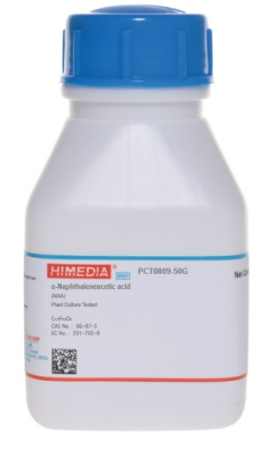
Naphthalene acetic acid (NAA) is a synthetic plant hormone from the auxin family widely used in plant tissue culture to regulate growth and development. It is considered a powerful growth regulator because it mimics natural auxins but is more stable, making it a critical component in various micropropagation protocols.
Key Roles in Tissue Culture
• Root Induction: NAA is primarily used to stimulate the formation of lateral and adventitious roots in plantlet cuttings and tissue cultures.
• Callus Initiation: At specific concentrations, typically combined with other hormones like cytokinins, NAA is effective for inducing and maintaining callus growth, essential for somatic embryogenesis.
• Shoot and Floral Regulation: It can influence shoot proliferation and enhance floral induction in certain species.
• Cell Division and Growth: Like other auxins, it promotes cell division and elongation.
Preparation and Solubility
NAA is not directly soluble in water; it must first be dissolved in a solvent before being added to culture media.
• Solvents: It is typically dissolved in a small volume of 1N NaOH, 1N KOH, or organic solvents like ethanol, acetone, or methanol.
• Stock Solution: A common stock solution concentration is 1 mg/mL. For example, 100 mg of NAA powder is dissolved in a few mL of solvent and then diluted to 100 mL with distilled water.
• Stability: It is generally heat-stable and can be autoclaved with the culture medium (typically 121°C at 15 psi for 20 minutes).
Usage and Concentration
• Effective Range: In tissue culture, NAA is often used in low concentrations, such as 0.1 mg/L to 10.0 mg/L.
• Toxicity: Higher concentrations can be toxic and may inhibit plant growth or cause abnormal development.
• Application: It is often added to standard media like Murashige and Skoog (MS) or Chu's N6.
Customer Reviews